What if you could try different paint schemes on your next custom piece before opening a single pot of paint?
If you paint and customize Mythic Legions figures, you know this moment well. A new unpainted part is sitting on your desk, and you still don’t know what colors it should be. Sometimes that part sits there for weeks, then joins the others. One of our customers once called his stack of unfinished purchases his “Big Pile of Grey Shame.” I laughed, because I have one too: pieces I printed for my own collection that are still grey, waiting for time, inspiration, or a clear idea of what they should look like. I suspect many of you have one as well. Sometimes the hardest part isn’t the painting itself. It’s deciding where to start.
Maybe you want that new part to match a figure already in your collection. Maybe you’re thinking about a different skin tone, a metallic finish, or something taken straight from nature.
Usually, you’d look for ideas in photographs, art books, or other people’s painted figures. But what if you could see those ideas on your own unpainted piece?
I’ve been experimenting with AI image tools to do exactly that. I think painters and customizers can get real use out of it, although there are a few things worth talking about first.
A Little Experiment at Dusk Till Dawn Studio
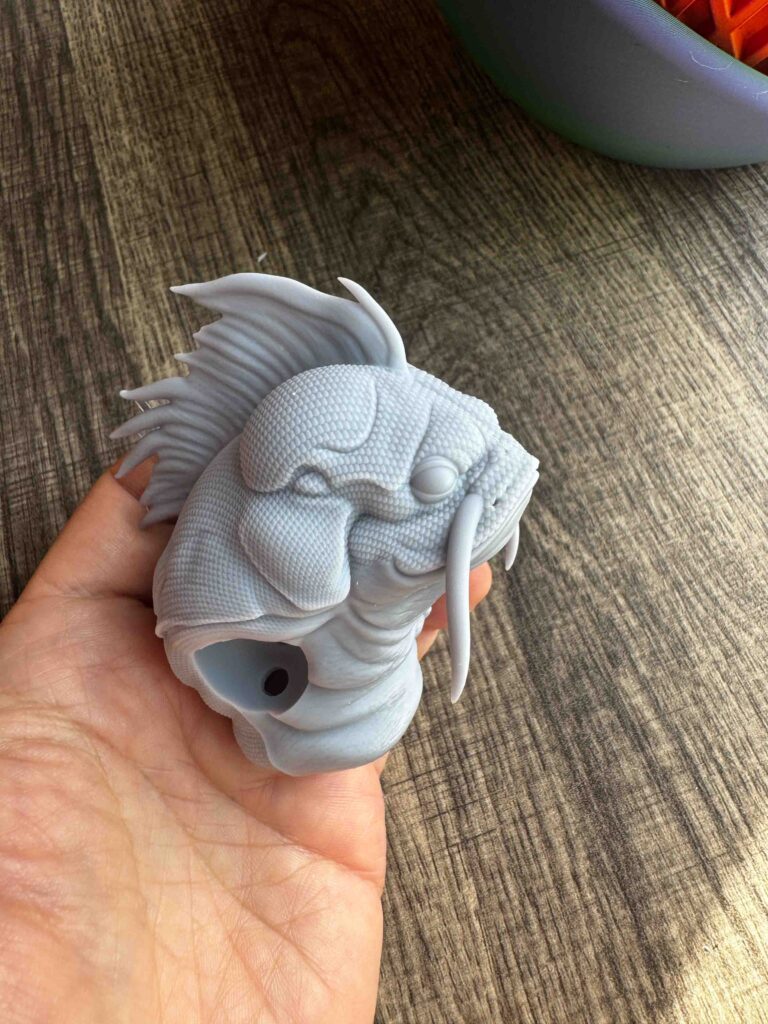
Our experiment started with The Fish, a resin torso with a sculpted, non-articulated head, designed by Jason Rodríguez for Mythic Legions 1.0 bodies.
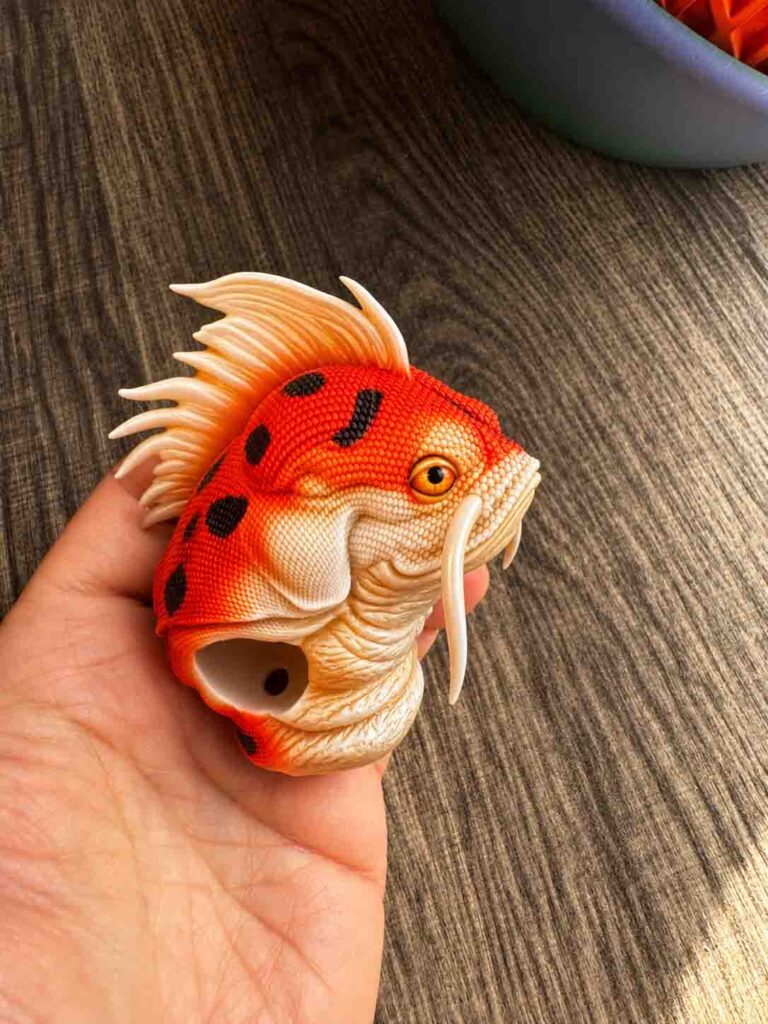
I wanted to see how it might look painted to match Qoi, the Amuurian navigator and harpooner of the Fishers Guild from Four Horsemen Studios. Qoi’s colors are inspired by Japanese koi: bright orange, cream, and black markings.
So I photographed the unpainted piece and uploaded the picture to ChatGPT, asking it to use Qoi’s colors as a reference while keeping the original sculpt.
The first results were interesting, but not quite right. I kept going, asking the AI to adjust the markings, remove some of the darker areas, and give it eyes like a real koi. After a few tries, I had a visual reference that could help someone paint The Fish to sit next to Qoi on the shelf.
Then I got curious. What if we dropped Qoi’s colors altogether and went with a real freshwater fish? I asked for natural brown and bronze tones with subtle iridescent highlights on the scales. Same photograph, completely different result.
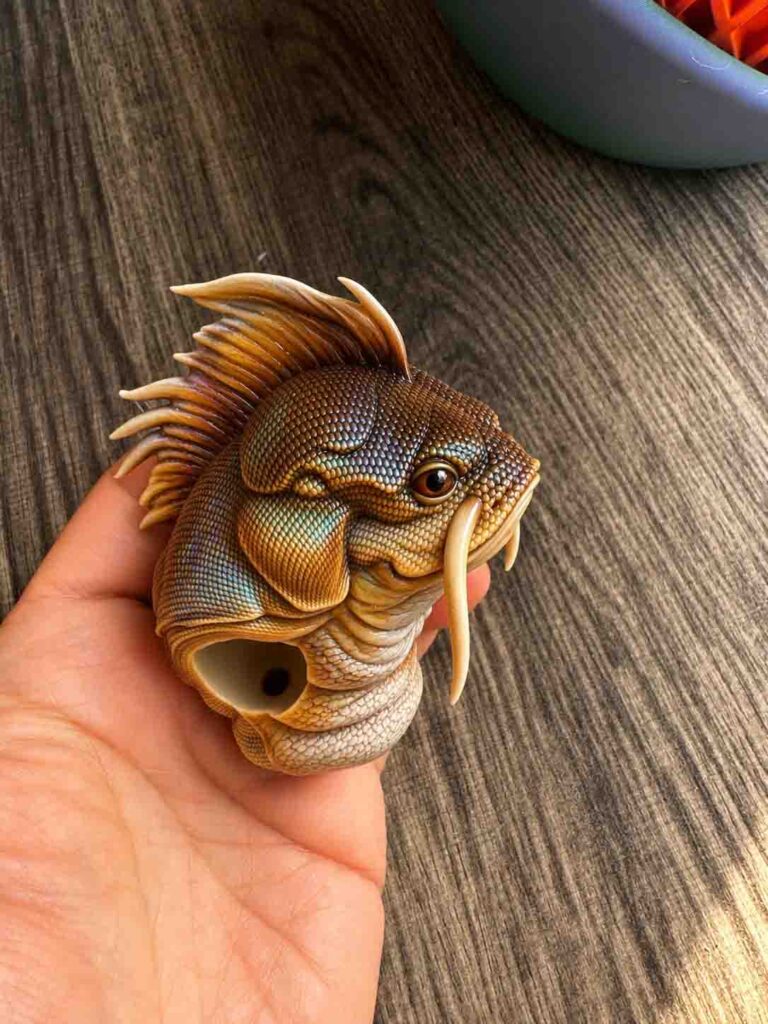
That’s when I saw how useful this could be. We started with one goal, matching an existing figure, and within minutes we were exploring paint schemes we hadn’t planned. The resin piece was still unpainted, and we already had several ideas to work from.
About the images: the painted versions in this article are AI-generated concepts, not photographs of actual painted products. The original sculpture was designed by Jason Rodríguez. Qoi, from Four Horsemen Studios, was used as a color reference.
AI and Our Hobby: I Understand the Concerns
Lately I’ve seen a lot of pushback against AI-generated images in action figure collecting and customizing groups, and I understand why. It can be hard to tell what’s real. Scrolling through endless AI images gets tiring when you’re looking for actual customs and hand-painted work. And it’s frustrating to admire what looks like a real custom figure, only to find out it doesn’t exist.
Those concerns are fair. Still, AI is a tool, and how we use it matters.
I’m not suggesting AI should replace painters, or that we should fill our groups with computer-generated pictures. I’m suggesting something much simpler: using it as a personal sketchbook. Painters have always found inspiration in photos, books, nature, and other people’s work. This is one more way to explore ideas, with the advantage that you’re working from a photo of the actual piece you’re about to paint. If you don’t like a color combination, you try another one right away. And you never have to share those images with anyone. They can just be references you keep at your workbench.
Why This Matters to Me
I also have a personal reason for being interested in this. Because of my visual impairment, painting miniatures myself isn’t really an option. My daughter usually paints the pieces I print for my own collection.
Sometimes I have a clear idea in my head, but explaining exactly how I picture the colors, shading, or small details is hard. Now I can photograph an unpainted piece, experiment until the image is close to what I imagine, and show it to her. Instead of describing every detail, I give her a visual reference.
The AI isn’t doing the painting, of course. She still chooses the paints, decides how to apply them and where the highlights go, and makes it all work on the real piece. Her skill is what brings it to life. For me, AI just makes it easier to share an idea, and I imagine other people could use it for similar reasons.
How to Try It Yourself
You don’t need to know much about AI or photo editing. All you need is a photo of your unpainted piece and an AI image-editing tool such as ChatGPT.
Start with a clear photo. Good lighting helps the sculpted details show up, and a neutral background helps too. Upload the photo and describe what you want to see. You can be very specific, or just ask the AI to surprise you.
Here are three prompts you can copy and adapt.
Prompt 1: Use Nature as Inspiration
“Using my uploaded photograph, show me how this miniature might look if it were hand-painted using the natural colors of a freshwater fish. Use brown, bronze, and olive tones, with subtle iridescent highlights on the scales. Preserve the original sculpt, proportions, textures, and details. Do not change the background or lighting. Make the result look like a realistically painted miniature.”
You can swap “freshwater fish” for almost anything: a tropical bird, a reptile, a butterfly, or the colors of a landscape you like.
Prompt 2: Match Another Painted Figure
This is the approach we used with The Fish and Qoi. Upload a photo of your unpainted piece along with a photo of the figure whose colors you want to match.
“I’m uploading two photographs. The first shows my unpainted miniature, and the second shows a painted figure whose colors I’d like to use as inspiration. Apply a similar color scheme to the unpainted miniature, matching the colors, shadows, and highlights as closely as possible. Preserve the original shape, proportions, and sculpted details. Keep the original background and lighting unchanged.”
This is especially handy when you want a new head, torso, or accessory to match a Mythic Legions figure you already own.
Prompt 3: Experiment with Painting Techniques
“Show me how this miniature might look painted using a dark brown basecoat, a black wash in the recessed areas, and lighter dry-brushed highlights. Add subtle edge highlighting to emphasize the sculpted details. Keep the finish realistic and achievable using traditional miniature-painting techniques. Do not modify the original sculpture.”
You can also try weathering, metallic finishes, non-metallic metal (NMM), or different levels of contrast.
Keep Experimenting, and Check the Details
You don’t have to get it right with your first prompt. Some of our best results came from asking for small changes, like these:
- “Try a darker, more natural color scheme.”
- “Remove the black markings around the face.”
- “Make the eyes look like those of a real koi fish.”
- “Add subtle blue and green iridescence to the scales.”
- “Keep the same colors, but make the finish look more weathered.”
Keep in mind that the AI will sometimes ignore or misread your instructions. It can change part of the sculpture, invent details, or come up with colors that would be hard to reproduce with real paint.
It happened to us. Compare the original photo with the AI versions below. In the freshwater version, the AI added scales to the smooth folds below the head, where the real sculpt has none. In the koi version, it added fine wrinkles to the same area. In both, the cool daylight of the original photo turned into warm sunlight, even though the prompt asked to keep the lighting unchanged.
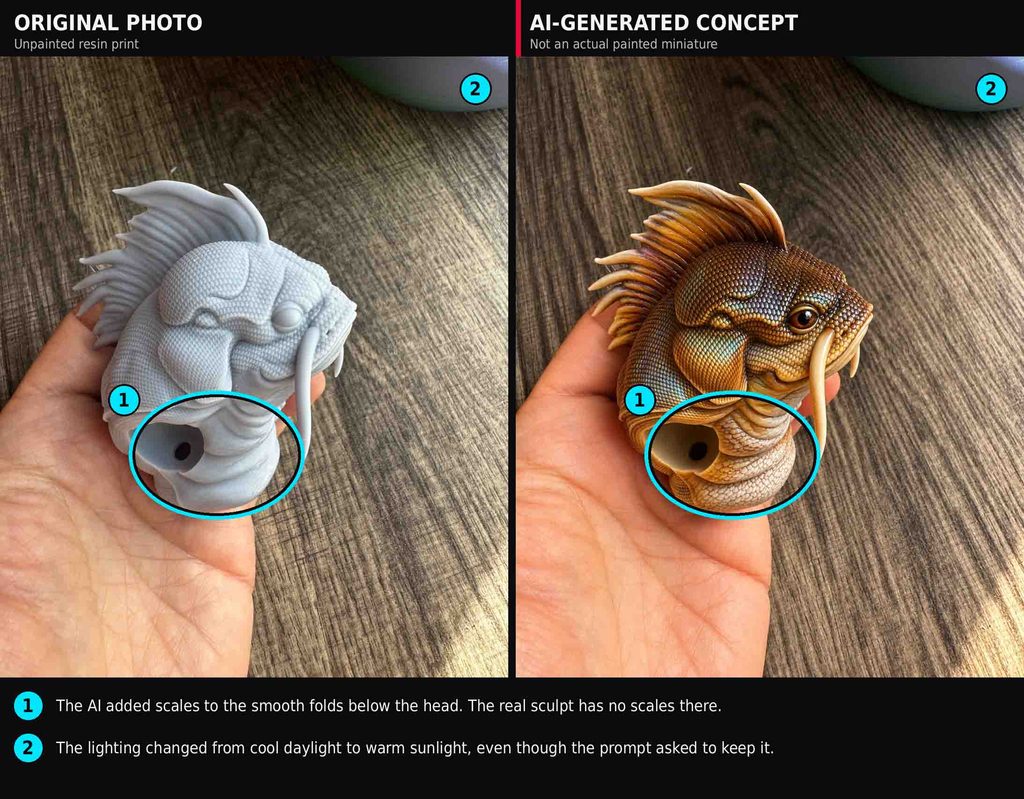
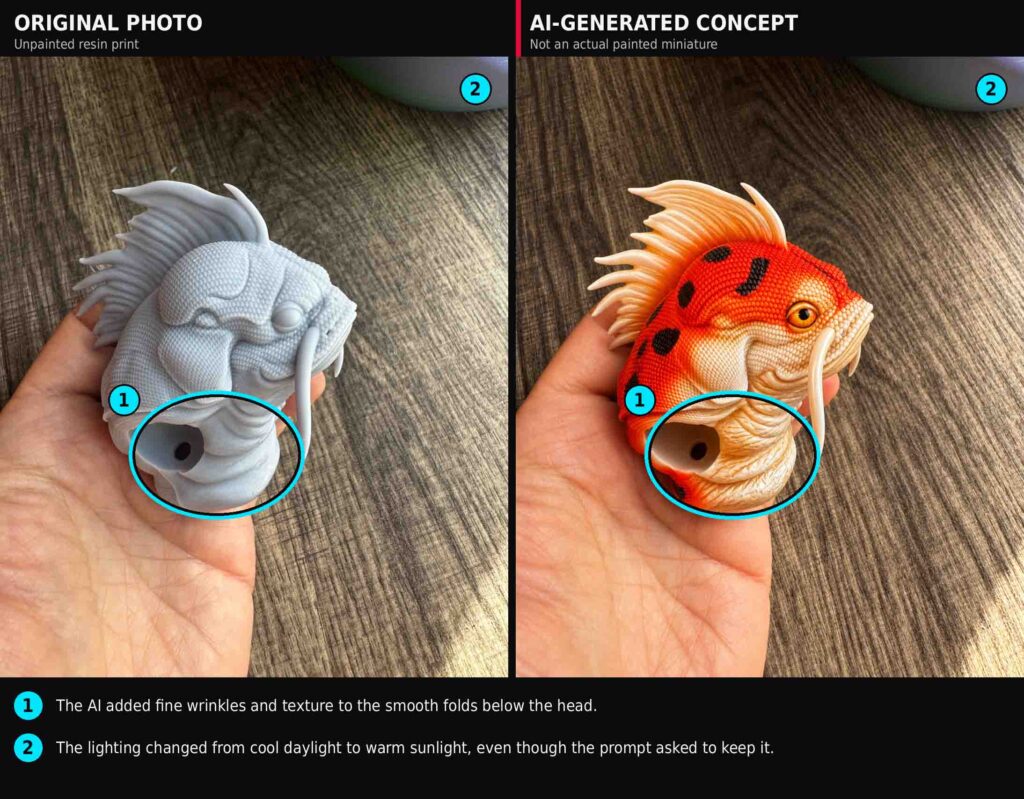
These images are creative references, not exact copies of the piece or step-by-step painting instructions. Always compare them with the physical part before you start painting.
Using AI Responsibly
For me, this is the most important part of the whole experiment. Using AI to explore an idea is very different from using it to make people believe something exists when it doesn’t.
At Dusk Till Dawn Studio, photos that represent products for sale should show the actual physical product. An AI-generated paint job should never be presented as a photo of a finished piece a customer can buy. That would be misleading, especially now that an imaginary paint job can look almost real.
If you share AI painting concepts publicly, label them clearly. Something as simple as “AI-generated painting concept — not an actual painted miniature” does the job.
We should also respect the work of painters, sculptors, and other artists. If an image is inspired by someone else’s work, don’t misrepresent their contribution or claim it as yours. And when you share a real painted piece, the credit goes to the person who painted it.
Playing with ideas and imagining a future project is part of the creative process. The problem starts when those images are used to fool people. We can enjoy what this technology offers and still respect the artists, collectors, and painters who make this hobby what it is.
The Real Painting Still Happens at Your Workbench
An AI image can suggest a nice color combination, but it can’t tell you how to get there. You still choose your paints, prep the surface, lay down basecoats, work the shadows and highlights, and decide when the piece is done. Sometimes what looked great on screen won’t work as well on the real piece, and that’s fine.
The reference is there to get you started, not to dictate how your figure should look. You might use the whole scheme, borrow a couple of details, or end up painting something completely different. The creative decisions are still yours.
Give It a Try!
If you have an unpainted head, torso, armor piece, or accessory from Dusk Till Dawn Studio, take a photo and try a few paint ideas. You might find a combination you’d never have thought of. If you want to repeat our experiment, The Fish is available in our store, and you can browse more torsos and heads for your next project.
If you use AI to plan a paint job for one of our pieces, I’d love to see how it turns out, especially the difference between your digital reference and the finished hand-painted piece. Just remember to label AI concepts when you share them, so nobody mistakes them for finished work.
The idea isn’t to let AI paint our figures. It’s to find new ways to imagine what we might create.
Bring your legends to life.